
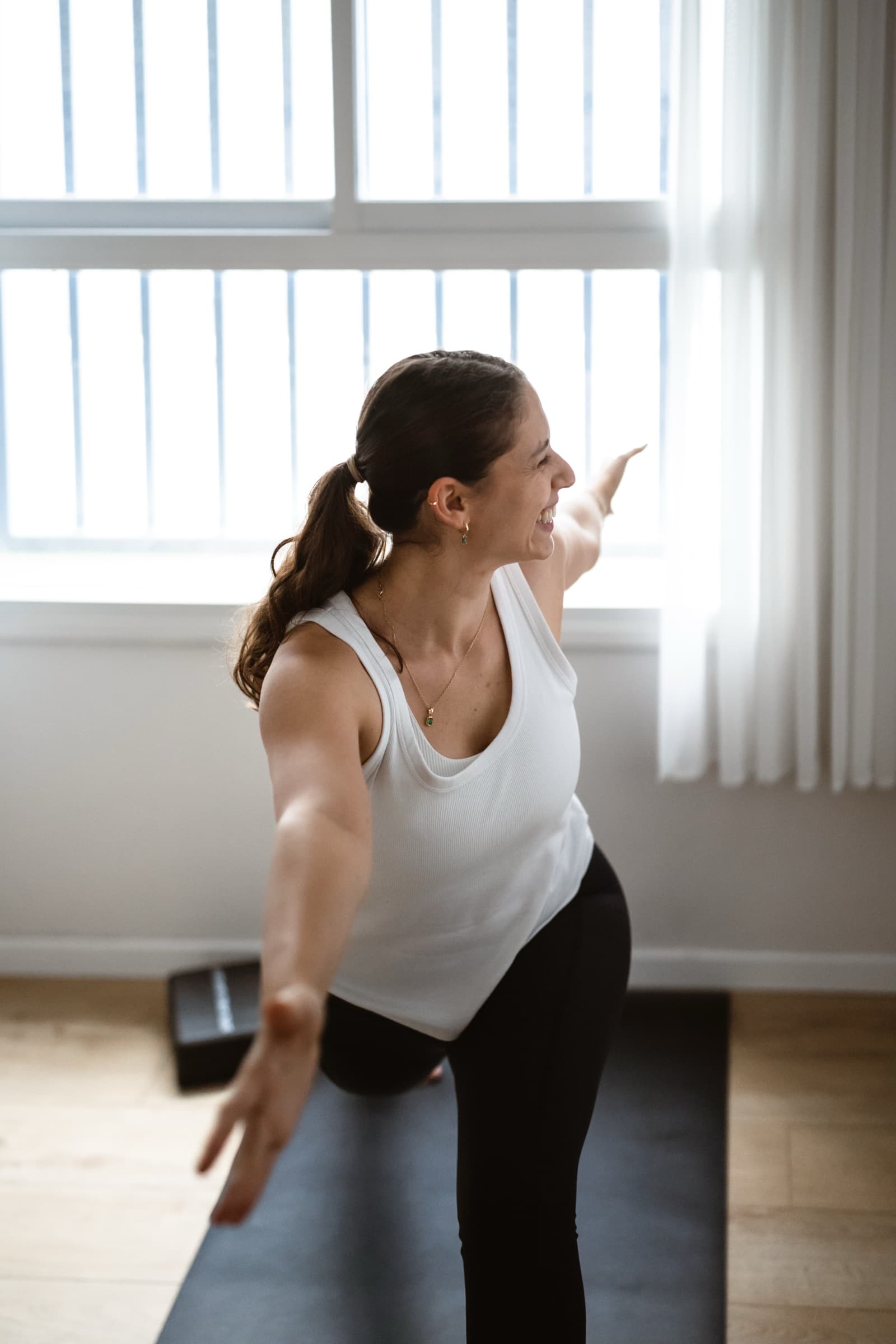
Knee pain was never something I suffered from, but throughout my training (as both a Pilates and a yoga instructor) I was taught how to guide exercises for clients with knee pain.
And then it was my turn…
A few weeks ago I twisted my knee during practice and oops… now I have knee pain too. For a few days I could barely put weight on my leg. I felt the pain mainly on the outer side of the knee. At first I was really down about it…
Then Wednesday came, the day of my yoga course – I got to class and couldn't do it along with the rest of the group.
My teacher took me aside, gave me completely different exercises from the rest of the class, and then it clicked! This injury was a gift for me as a yoga and Pilates instructor.
It gave me all the information I need to train injured clients, to identify with their pain, and to understand exactly what works and what doesn't…
And that's how the idea for this blog post came about: I want to share the knowledge I've gained.
I'm going to share four exercises that helped me significantly with my knee pain, and I really hope they help you too.
They're also great for people without knee pain who want to get stronger and prevent future injuries.
Before we start, let's understand why the knee is such a sensitive area, exposed to so many injuries.
The knee is a large joint and one of the most complex in the body. It's made of four bones – the femur, tibia, fibula and kneecap – connected by muscles, ligaments and tendons.
The muscles attached to the knee through tendons are the quadriceps, responsible for straightening the knee; the hamstrings, responsible for bending it; the popliteus, responsible for rotating the knee inward; and the biceps femoris, responsible for rotating it outward.
The knee supports the body's weight and transfers loads from the ground, but the knee joint is very complex and inherently unstable. That instability is what exposes our knees to injury.
To prevent knee injuries, we need to strengthen the muscles that move the knee (mainly the quadriceps).
Here are four exercises you can also do on your own at home, to strengthen the muscles that hold the knee and take the load off it:
Squat: strengthens the quadriceps. To do it correctly, make sure your knees don't collapse inward; keep your weight evenly on your feet; send your pelvis back; and keep a 90-degree angle at the knee. Hold the squat for 5 deep breaths (about half a minute) and repeat 5 times.
Straight-leg raise: can be done standing, or sitting leaning back on your elbows. Here we strengthen the quadriceps while the knee is straight and held still; keep the leg straight in the air, lifting toward your chest. Again, hold for 5 deep breaths. Do both legs, 5 repetitions each.
Walking backwards: an effective technique for strengthening the hamstrings and taking load off the knees. We recommend 10 minutes of slow backward walking a day.
Calf raises: rise onto your toes and lift your heels, to strengthen the calves as well as the quadriceps we've already talked about. Stand on the balls of your feet for 5 deep breaths, 5 times.
Important! What's written here is not a substitute for a diagnosis by a doctor or physiotherapist.
But after thorough research and from our professional experience, we've learned that if we suffer from knee pain – or pain in general – we shouldn't stay home in bed. Quite the opposite! We need physical activity that helps reduce the load on the muscles – like the yoga and Pilates classes at our studio.
More from the journal
· 2 min read
If I didn't sweat, does it still count as a workout?
You know that moment when you leave the studio, look in the mirror and suddenly think:
· 3 min read
My doctor told me to start Pilates
The information in this post is based on my personal and professional experience and is not a substitute for medical, physiotherapy or any other professional advice. For any medical question or limitation, consult your doctor or treating professional.
· 2 min read
Family movement
The summer holidays bring plenty of challenges – routine, screen time and the endless search for something to do – but also a great opportunity: family quality time that doesn't have to mean screens or another trip to an air-conditioned mall with junk food.